

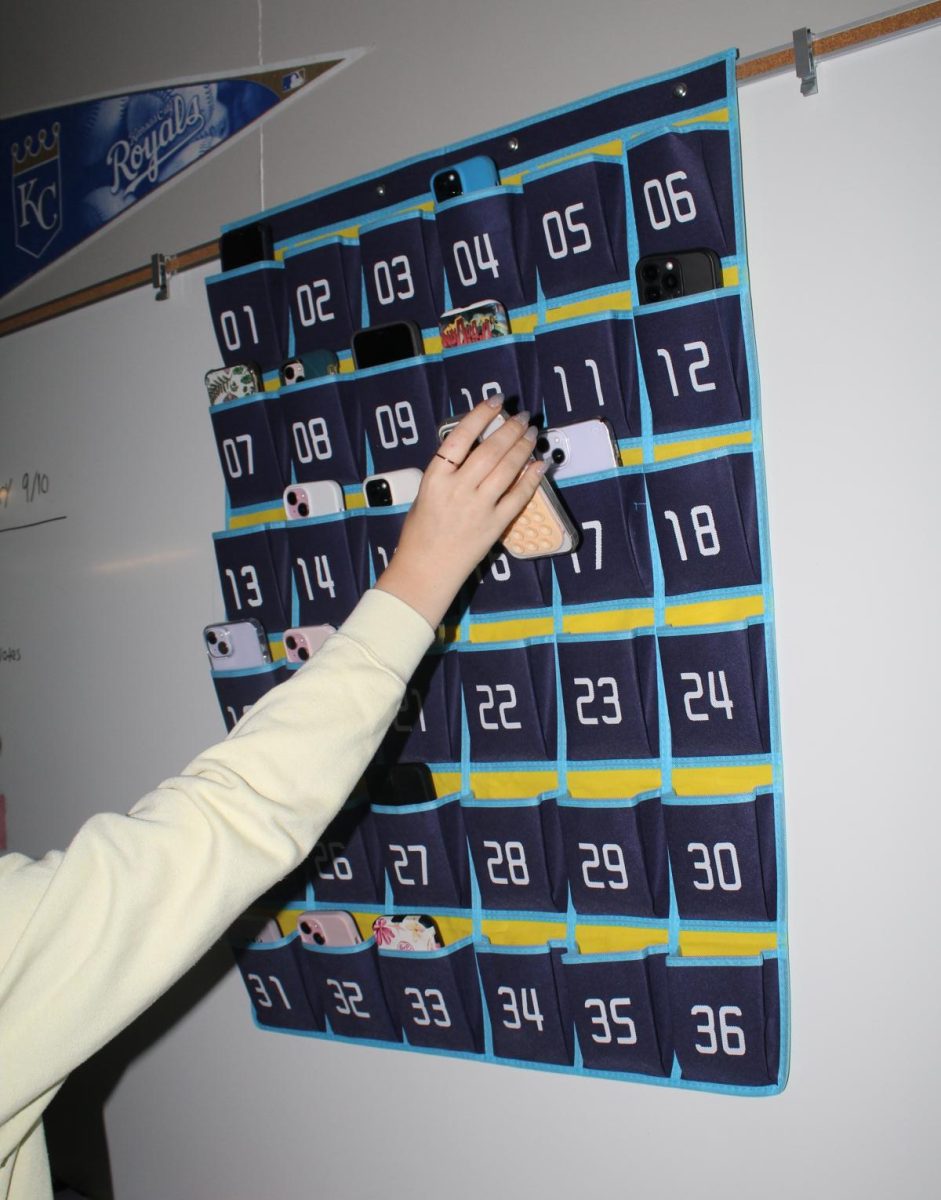
Missouri recently passed a law called the Missouri Senate Bill 68 to require school districts to restrict cell phone usage to only emergency situations. Liberty Public Schools, in response to this law, set perimeters where phones and other personal devices are no longer allowed to be used during the school day.
“As phones have become more commonplace throughout our society, cell phones have become more complicated. What was once, literally, a phone that you can carry in your pocket, became a phone, became a calendar, became maybe a few productivity tools, became a messaging app. Then, it became Snapchat, and social media, and so many other things that it would do,” principal Dr. Rosemary Camp said.
On the LPS website, the page for cell phone use policy further elaborates on what exactly is not allowed to be used. This ban doesn’t just extend to phones, it extends to an array of devices. The list of devices that are prohibited during school hours are: cell phones, smartwatches, gaming devices, personal laptops, and tablets.
“There were a few iterations of it. The final version that comes down, that is signed by the governor of Missouri into state law, says that students may not use personal electronic communication devices during the school day. So, from the opening bell of school until the closing bell of school, no personal electronic communication devices in schools in the state of Missouri,” Camp said.
If the list of devices wasn’t a surprise, what hadn’t been expected was that these devices were to be put away during the entirety of the school day. The website lists these times and areas for when these devices are prohibited: class, flex hours, assemblies, lunch, restroom breaks, and passing periods.
“I was pretty surprised and a little sad because I had gotten used to having my phone out in class and using it throughout the day,” junior Kate Grey said.
North itself wasn’t super strict on its policy making, as teachers also had a say in how they wanted their class rules to look. This meant that the rules in place, like filling out hall passes and how phone usage looked, applied differently depending on who the teacher was. With the new bill, these differences became one concrete understanding of how to apply the law.
“It’s something that’s not going to be all that flexible. There’s no “well in this class, but in this class”. It really shouldn’t be that way anyway, now and with Senate Bill 68, I think it is supposed to be more uniform, so kids aren’t confused as to when they can or can’t,” English teacher Jon Dolton said.
The intended outcome of the policy, according to the LPS district, is to help students build healthier, more productive technology habits. Enforcing the phone ban also meant having to navigate how students respond to the cell phone usage policy from a staff member’s standpoint.
“If all I’m doing is monitoring the cell phone on your person, that gets in the way of good instruction and good teaching and learning. We wanted to provide support and infrastructure so that students understand we’re serious about following this law. We want you to get the best education you possibly can while you’re here at Liberty North,” said Camp.
This change has also been applied to staff members at North. It’s not just up to the students, it’s also up to the teachers, administrators, and security guards to ensure that the law is being followed accordingly.
“As far as monitoring, it’s just everyone has been really receptive to us just telling them to put their phones away. We haven’t had any really major issues with students not listening about not using their phones. I’m hoping it’s helping them in the classrooms,” Internal Security Officer Phil Bradshaw said.
For teachers, it’s also been a change in their own classrooms. The transition from monitoring students’ phones to not having them present has posed new observations seen from their students.
“They all have a blanket understanding of no phones. Last year, it was on certain days, no phones. So, the benefit for me is that’s where we start and so I don’t have to ask them,” science teacher Scott Le said.
Having students be more engaged in the lessons, it also gives teachers room to provide students with what is necessary from that lesson. Without phones having the communication barrier, it also gives students the opportunity to be more open and engaged with their teachers.
“During notes or during assignments, we’re doing things that it would be nice to have some student’s participation or input. If everybody was on their phones, it would just be like talking to crickets. If everybody is focused and has their phone away, then there’s more likely to be somebody who says something or interacts with me in a certain way, which is always helpful,” Le said.
Of course, there are challenges involved in monitoring, but the staff have approached the manner in which students are receptive to being told to put their phones away in a secure place.
“We’ve approached the kids about it, just kinda saying, ‘Hey, can you please put that away? We’re a phone-free zone.’ Being on an even field, and not making it a huge deal makes a big difference,” Bradshaw said.
The social atmosphere has also changed for many. Many students have been seen being focused, seen being more engaged in the content, and seen communicating with other students more.
“Kids talk to each other more. Their heads are up and they’re talking to each other more. They feel like they’re more a part of a community, because the community didn’t just shut down to be on their phone,” Dolton said.
Incoming freshmen who have followed a strict cell phone policy in middle school have had to learn that the new policy would not allow them to use their cell phones, despite what they’ve learned from the previous high school cell phone policy.
“I feel like it would’ve been harder for sophomores, juniors, and seniors where they were exposed to high school with phones but since I was coming from middle school, where they were still pretty strict about phones, it wasn’t super shocking,” freshman Lena Roth said.
When it comes to phone usage, there will always be downsides that come with the change at hand. A large barrier that has been introduced with the ban is how extracurriculars and clubs are finding ways that they can communicate effectively.
“With activities, not being able to just quickly communicate is a big problem. Sometimes you think of your best information that you need to send out when you’re sitting in the middle of an ELA class and just would like to send it out during passing period so you can just get it out there. Instead, you’re just trying to remember to send out a text message for 8 hours later because of the school day,” senior Chloe Williams said.
Broadcasting’s usage of technology allows them to conduct interviews, take photos for stories, and provide students with an effective method to get their tasks done, all ready for the daily broadcasting of KNET. With the phone ban, the way this gets done has also changed.
“We now all have to have passes around our neck to carry around with our phones and interview people. You get a couple of crazy looks when you’re watching an activity or a club meet or in a classroom and you pull out your phone to record b-roll. It’s definitely something that we’d have to overcome and with the phone ban, there’s already wings where you can’t get good service anyway. It just made it worse,” Chloe said.
Another challenge without the phones also poses a challenge for students who struggle with communication. Without the communication barrier provided by the phones, concerns rise for how students can navigate a social dynamic they’re not used to. For example, with the different lunch shifts where there’s no guarantee you’re assigned the same lunch due to class scheduling.
“I grew up in California, where everybody had lunch time at the same time. If you went to lunch, you were with your friends. With lunch shifts, it doesn’t always work that way. My youngest started at LHS as a freshman and she was worried about what friends she’d have to sit with at lunch during the summer. So, I understand this is a more complex issue than just turning them off,” Dolton said.
Since people are also used to being on their phones during class, what students do after work time is also an adjustment. Usually, the phone would help pass time when their work is done.
“A lot more people are getting a lot more work done. But, a lot of people are bored a lot of the time too,” Kate said.
Along with the phone ban came other building restrictions. Seniors at North came in with minimal restrictions to, where now, there’s Smartpass, freshmen not FLEX spaces other than the cafeteria, and limited places to go during events like assemblies.
“I do like that the freshmen are now corralled in the cafeteria. Courtesy of our class, not me, but we collectively were so bad that they had to do that,” senior Luke Winn said.
This also includes spaces in the school where there is a lot of seating. Currently, these areas are not in use, usually serving as areas for classes to use on occasions, meetings, and some were utilized by North Nation By Design.
“We have a lot of open areas that could and should be used as FLEX spaces that are just not being utilized. I think we have enough security guards that we could use those spaces. Like the area by the blue stairs. There’s a lot of open seating there but nobody gets to use it unless it’s for class,” Luke said.
With limited areas, Smartpass has also come with a lot of processes being digitalized, i.e., the hallpasses and the school IDs. While there is not much of an issue of having a digital system of monitoring students for safety reasons, with the banning of cell phones, having a convenient way to use these resources has proved to be a challenge.
“I wish we still could just use our regular ID to still get into football games and dances because it just takes a level of how hard it is to get around. With the new phone ban, I still have to have my phone and my ID, but I’m not supposed to even exist in the realm of my phone. It’s kind of weird,” said Chloe.
As the school year progresses, there’s no telling how this will look long-term, but if anything is for certain, it’s that the efforts to adjust are coming from students, staff, and administrators alike. There may be problems that will arise with any new development, but students can hope that the original intention of the law aids in their student success rather than providing a barrier to it.
“I hope long-term that we’ll see student success increase. There’s a lot going on here. I feel like the more engaged students are, the more successful they’re going to be with all of the programming we have. It’s just one less thing to worry about when they’re put away so we can really dialogue and engage,” Camp said.